

Your $500/mo SaaS Stack Is Becoming a Single AI Agent
The agent economy is here. Here is what it costs you if you ignore it.
$285 billion wiped from SaaS stocks in a single trading session in February 2026. Not a recession. Not a scandal. Just investors realizing that the software you pay for every month can now be replaced by an AI agent that works 24 hours a day and never asks for a seat license.
Most founders are responding to this by bolting a chatbot onto their product and calling it an AI upgrade. That is the wrong move. The companies watching their valuations collapse right now did exactly that. Salesforce fell 7%. ServiceNow dropped 7%. Intuit lost 11%. These are not struggling businesses. They are billion-dollar platforms being repriced by the market in real time.
This issue breaks down what is actually happening, where the money is going, and exactly what you need to do before your product ends up on the wrong side of this shift.
The SaaS Model Is Not Dead. It Is Forking.
Here is the part most people miss. SaaS is not dying. It is splitting into two tracks, and which track you are on determines everything.
Track one: legacy SaaS. One tool per task. Per-seat pricing. Horizontal features that have not been rebuilt for agentic workflows. These are the products getting replaced.
Track two: AI-native SaaS. Products where AI is the core, not the add-on. Spending on these platforms jumped 108% year over year according to Zylo’s 2026 SaaS Management Index. Among large enterprises, that figure was 393%.
The market is not confused about which track wins. Gartner projects that 35% of point-product SaaS tools will be replaced by AI agents by 2030. IDC forecasts over 1 billion actively deployed AI agents by 2029. That is a 40x increase from 2025 levels.
Bad: Add an AI feature to your existing SaaS product and market it as an upgrade.
Good: Rebuild your core product interaction around an agentic model where the product does the work, not the user.
The Numbers Nobody Is Quoting Correctly
Let me give you the real data because there is a lot of noise in this conversation.
The agentic AI market sits at $8.5 billion in 2026 and is projected to reach $45 billion by 2030 according to Deloitte, a 53% compound annual growth rate. Fortune Business Insights puts the 2026 figure at $9.1 billion with a trajectory toward $139 billion by 2034.
Two credible sources, two different endpoints. The disagreement is about the ceiling, not the direction. Both agree: this market is growing faster than almost anything in enterprise software
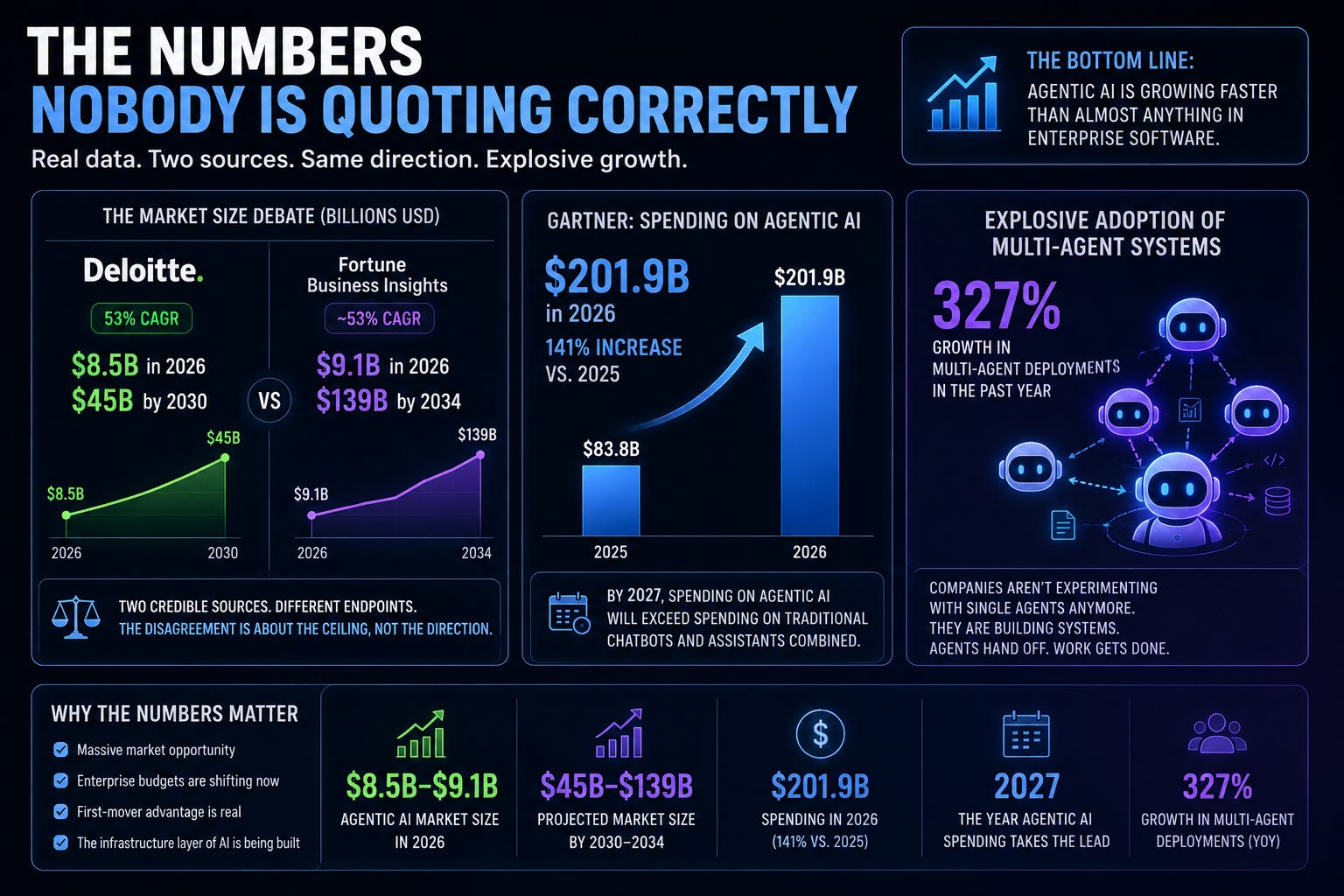
Gartner reports that spending on agentic AI will reach $201.9 billion in 2026, which is 141% more than 2025. By 2027, spending on agentic AI will exceed spending on traditional chatbots and assistants combined.
Meanwhile, multi-agent deployments grew 327% in the past year. Companies are not experimenting with single agents anymore. They are building systems of agents that hand off tasks to each other across entire business workflows.
Bad: Watching competitor benchmarks and waiting for the market to stabilize before acting.
Good: Auditing your tool stack now and identifying three categories that a single orchestrated agent could replace by Q4 2026.
The Controversial Truth About Who Survives
Here is the controversial truth: the SaaS founders who will survive are not those who add AI features. They are those who make the product disappear.
When your product requires a human to log in, navigate a dashboard, and make decisions, it is a tool. Tools get replaced. When your product operates autonomously, learns from your business over time, and delivers outcomes without human input, it is infrastructure. Infrastructure does not get replaced. It gets depended on.
The memory layer is where real moats are being built right now. An agent that has processed 18 months of your sales calls, your CRM data, and your customer success tickets knows your business in a way no new entrant can replicate on day one. That is the defensible position.
Vertical SaaS is also surviving for the same reason. Specificity agents cannot match, yet. A compliance tool built for a single regulated industry carries institutional knowledge, audit trails, and regulatory context that a horizontal agent cannot absorb from a prompt. That specificity buys time.
Bad: Building a general-purpose product that competes with horizontal agents on breadth.
Good: Going deep on one workflow, one industry, or one painful outcome that agents cannot fully own without your proprietary data layer.
Cognition AI: A Case Study in What Winning Looks Like
Cognition AI, the company behind Devin, the world’s first autonomous AI software engineer, just raised $1 billion at a $26 billion valuation in May 2026. That valuation more than doubled from $10.2 billion just eight months prior.
Here are the numbers that matter. Revenue grew from $37 million to $492 million in 12 months. Enterprise usage of Devin grew more than tenfold since January 2026. And here is the one that changes the conversation: 89% of code committed at Cognition’s own engineering team is now written by Devin.
Mercedes-Benz reduced an eight-month legacy modernization project to eight days using Devin. Brazilian banking giant Itau now resolves 70% of security vulnerabilities automatically. Goldman Sachs and the U.S. government are active customers.
This is not a demo. This is a company that replaced a traditional software development workflow with an agent, charged for the outcomes, and scaled to half a billion in annual revenue in one year. That is the blueprint.
The Post-Agent Product Audit (Do This This Week)
Run this process with your product team before the end of the month. It takes about three hours. It will change how you roadmap the next 12 months.
1. List every SaaS tool in your stack: Group them by job-to-be-done, not by vendor category. You are looking for clusters of tools doing the same underlying work.
2. Identify the three highest-cost human-in-the-loop steps: These are the steps where a person logs in, reads a report, and makes a decision. These are your replacement candidates.
3. Build or buy an agent for the most repetitive one: Start with one workflow. Use Zapier Agents or a custom LLM pipeline. Measure hours saved and seats you can drop.
4. Find your memory layer: What proprietary data does your product accumulate over time that an agent would need to do the job well? That data is your moat. Protect it. Build on it.
5. Define your post-agent pricing model: Seat-based pricing is dying for your category too. Identify what outcome you can charge for. Time saved, errors prevented, revenue generated. Build a pricing experiment around that metric this quarter.
Tools Referenced This Week
AI Tool of the Week: Zapier Agents. Zapier has transformed into an orchestration hub. Founders can build multi-step autonomous workflows without engineering resources in under an hour. Start here before you hire a developer for agent work.
Startup to Watch: Cognition AI (Devin). $26 billion valuation. $492 million ARR. 89% of their own code written by their own AI. The clearest proof case that agentic software engineering is not a future concept.
Productivity Tip: Replace your meeting note-taking and action item tracking with a single AI agent pipeline: Otter + Zapier + Notion AI. Done correctly, this saves 5+ hours per week per team member. Run a two-week pilot and report back.
Warnings Nobody Gives You
Warning 1: The trust gap is real and expensive. Only 6% of companies fully trust AI agents for autonomous execution of core processes. If you build an agent product, your first 90 days will be spent earning that trust. Budget accordingly. One public failure in your customer base sets you back 12 months.
Warning 2: Agents are not replacing SaaS categories evenly. Customer success, legal review, and HR onboarding are moving fast. Security and financial compliance are moving slowly because the regulatory stakes are too high for autonomous execution. Do not build your entire roadmap assuming uniform adoption speed.
Warning 3: The API bill will shock you. I have seen early-stage teams burn $8,000 in a single month on LLM API calls because they built an agent without output caching, prompt compression, or rate limiting. Set a hard monthly cap before you launch anything to users. This is not optional.
Warning 4: Big tech is moving through acquisition. 75% of recent major tech deals have been AI acquisitions. If you are building in this space, you will face either an acquisition offer or a well-funded competitor backed by a platform. Neither is automatically bad. But both require a clear answer to the question: what do we have that they cannot replicate in six months?
This Week in the Community
Poll: Have you started replacing any SaaS subscriptions with AI agents in the last 6 months? Reply to this email with Yes or No and which category. We will publish results next edition.
Discussion: Which SaaS category do you think AI agents will fully replace first, and by when? Drop your answer in the comments.
Forward this to your product team. This is the strategic conversation every SaaS company needs to have right now.
The agent economy is not arriving in 2028. It is repricing your competitors and your customers right now. The founders who move this quarter will have 18 months of data, a working memory layer, and a post-seat pricing model before the rest of the market figures out what is happening. Do not be the person who read about this and went back to their dashboard.
To your hustle,
Startup Digest
startupdigest@substack.com
thestartupdigests.substack.com